


Call Sheets 101 (Scripted TV)
- Shannon Devine

- Jul 25, 2021
- 5 min read
Updated: Apr 2, 2022
I'll be the first person to tell you that I did not understand the very first Call Sheet I was sent. At university I had created my own Call Sheets based on industry templates but it did nothing to prepare me for the real deal.
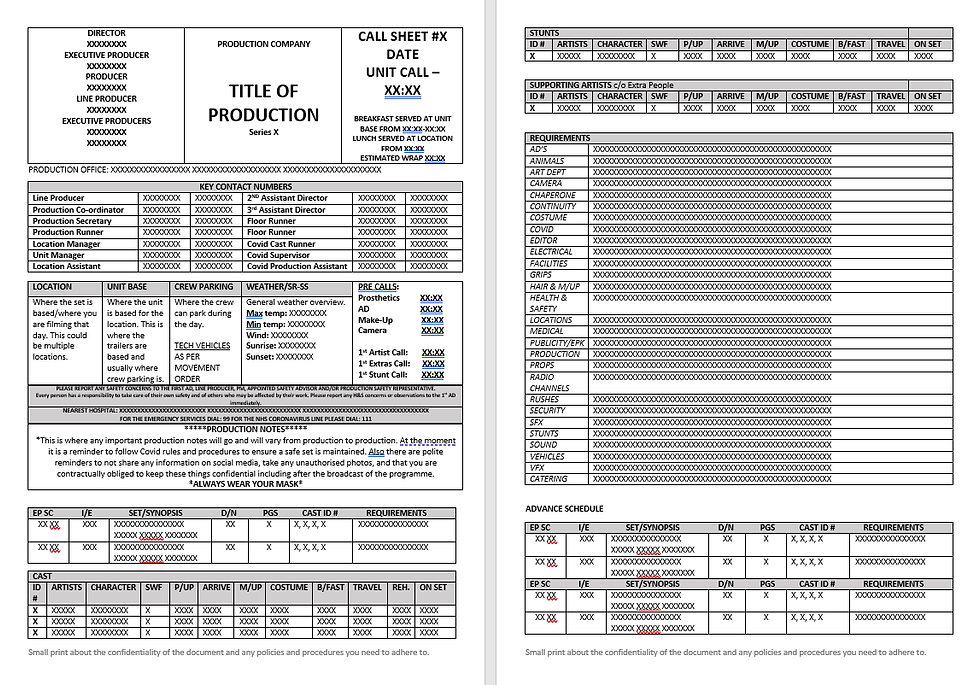
Below is a rough template I made to illustrate the points discussed in this post. As you can see, if this was full it would be quite a lot to take in at first and if you don't know what you're looking for or what is relevant to you, you could easily get lost in a sea of information. Put simply, Call Sheets can be broken down into 10 sections. Here's what I learned from my fellow Runners on my first paid television job:
1. Basic Production information.
The names of the Director, Executive Producers, Producer, and Line Producer, the name of the Production Company, the name of the Production, Call Sheet number, date, Unit Call time, breakfast/lunch serving times, estimated wrap time.
You should get to base for breakfast or definitely with enough time to prepare before the Unit Call. The Unit Call is the time everyone will head to set - if set is further than a short walk from base, some people will drive themselves over but commonly you'll be travelling via minibus and tech vehicles tend to be parked close to set. There are generally three different types of working day and which one the production is working to that day will be stated on the daily Call Sheet. These are a standard 10-hour shooting day with a 1 hour lunch break, a semi-continuous shooting day where lunch break is 30 minutes, and a continuous shooting day where there is no official lunch break and breaks are allotted at appropriate times. I've learnt that the majority of the time you will be working on semi-continuous days and Fridays sometimes swap to continuous to cater for an earlier wrap time.
2. Key crew contact numbers.
These include the main members of Production and their phone numbers should you need to contact them. These are the Line Producers, Production Co-Ordinators, Production Secretary, Production Runners, Location Managers, Unit Managers, Location Assistants, 2nd AD, 3rd AD, Floor Runners, Covid Supervisors, Covid Assistants, Unit Medic. Other key members of crew may also be listed depending on the size of the production.
3. Locations and Pre-Calls.
"Location" is usually where set is/where you are shooting that day. "Unit Base" is where the production is based while on location and the place where you will find the trailers for the Production office, Make Up department, Costume department, and cast trailers. Usually you should report to Unit Base before heading to location but this will be stated on the daily Call Sheet in the Production notes. Pre-calls are for the departments who need to be on set/working before the Unit Call and can include departments like ADs, Prosthetics, Make Up, Costume, Camera, etc.
4. Important notices and Production notes.
These tend to include things like who to contact for health and safety concerns, the nearest hospital in case of emergency, and emergency contact numbers. Production notes will vary from production to production but the one I'm currently working on have included things like Covid reminders, confidentiality reminders, reminders not to share any information about the production or share photos on social media, reminders not to share the locations or names of cast members, and mental health awareness notes.
5. A schedule for the day's shoot.
These are laid out in a table with sections including episode and scene numbers (EP SC), whether the shots are interior or exterior (I/E), set and basic overview of the synopsis/what happens in the scene, whether the scene is shot day or night (D/N), which pages of the script are in the scene and how much of the page is being shot in the scene, these are split into 1/8ths (PGS), the cast members needed listed by identification number, and any other requirements for the day like Supporting Artists/Extras.
6. Cast members.
This section lays out the cast's schedules for the day including their character name, the time they are picked up, arrival on base, time they need to be in make up and/or costume, time they have breakfast served to them, times they travel, and times they have to be on set or in rehearsal. This is also where cast members are listed with their associated identification number which is used in the schedule above to show a quick overview of who is needed in which scene. Never refer to the cast as these numbers, they are purely there to save time and space on the Call Sheet.
7. A similar section to above but for Stunts, Stand ins, and Supporting Artists/Extras which lays out the times they need to be in each department before coming to set.
8. Requirements.
This is a long list department by department with heads of department and contact numbers. Every department is listed even if they are not needed for the day, and these include things like Catering, the times meals are served, and all the information you need about the radio channels and which department works on which channel, and who the Medic is. Generally channel 1 will always be the main unit channel/AD channel where all the action takes place and other departments will work on their own channel so if you need to contact Locations directly, for example, you wouldn't have to interrupt the main channel with your request.
9. Advance schedule.
Similar to the schedule for the day but set out for the next couple of days with a basic overview of the location, the scenes being shot, and the time of Unit Call.
10. Transport.
A list of all the drivers working that day and a schedule of who they need to transport in the morning and at the end of the day. Their contact numbers are also listed should you need to contact them but you should rarely need to. Working on this production we had multiple WhatsApp groups, one of which included the transport team and was used to keep everyone up to date about where transport were and when they were travelling between base and location. I personally had to use this chat quite a lot to ask for top ups of hot water, coffee and tea supplies, milk, bottled water and for requesting morning and afternoon snack to be sent to location.
At the bottom of each page in the footer is also a reminder of the confidentiality of the document and that the paperwork should not be left laying around. Call sheets should only be printed and distributed as needed and should be appropriately disposed of at the end of the day. There may also be a reminder here of any other policies and procedures that need to be adhered to throughout the day.
That's it! That's your basic run down of a Call Sheet in Scripted Television (or at least from the production I have been working on - although I assume they are all in the same or a similar format throughout the industry.) Once I had someone explain it to me and I had some more time to look at it properly without the pressure of the first few days of a new job, I got the hang of reading the document pretty quickly. Hopefully this has been able to shed a little light on what initially is a very information heavy and intimidating document!
SD x


Comments